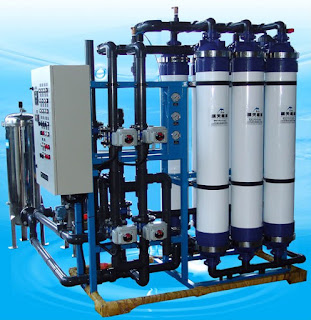
Water treatment equipment is the process in which water from various sources is treated to a water quality or standard that meets its intended use. since the beginning, the objective of water treatment has not changed i.e. to produce water that is free of chemicals and microorganisms, and is aesthetically pleasing too.
One of the earliest
water treatment equipments techniques – boiling of water, is still valid and widely practiced today. Other methods include heating water in the sun or purifying it by filtration through sand and coarse gravel. Ancient Egyptians (1500 BC) reportedly used chemical alum (aluminium sulphate) to react with suspended particles to settle out of water. In the 5th century BC, the Greeks used cloth bags to strain rainwater. In the 3rd century BC, public water supply systems were already developed in Rome, Greece, and Egypt. In 1804, the first municipal water treatment plant was installed in Scotland. The filtered water from the plant was distributed by horse and cart. In 1807, piped water was supplied to consumers. The first slow sand filter was installed in London in 1829 to treat water from River Thames.
Health and Environmental Concerns:
The early concern in
water treatment equipments system (from mid-1800 to mid-1900) was the elimination of waterborne disease such as typhoid fever and cholera. Many epidemic diseases then were often waterborne i.e. spread through consumption of contaminated drinking water. During this period, microorganisms (mostly bacteria) causing specific diseases were identified, isolated, and studied. Testing methods e.g. the coli-form test were developed as a means to establish the presence of sewage contamination.
Chlorine and ozone were applied to treated water for disinfection. By 1950, the majority of water supplies in developed countries are micro biologically safe. However, it was also discovered during this time that there were some infectious agents (viruses) that are much smaller than bacteria that can also cause diseases In the last three decades, health concerns shifted from waterborne disease causing acute illness to the chronic effects caused by trace quantities of anthropogenic (man-made) contaminants.
The development of specialized equipment like gas chromatography and mass spectrometer in the 1970 allows trace levels of man-made organic compounds to be detected. With the great improvement made in the analytical capabilities, a vast array of regulations was designed to address these risks. One of these is related to the formation of chemical byproducts of the disinfection process (disinfection by-products DBPs). It was demonstrated that chlorine disinfectant can react with organics in water to form trihalomethanes (THMs) which are carcinogenic. Other commonly used disinfectants such as ozone and chlorine dioxide can also produce DBPs – bromate and chlorite, respectively. This eventually leads to a trade-off between using disinfection to control microbiological risks and preventing the formation of undesirable man-made chemicals caused by disinfectants.
Focus Engineerrs - Dosing Pump Manufacturer India:
It is during the last decade or so in balancing the above trade-off, a new microbiological issue began to emerge. Pathogenic protozoa that are zoonotic in origin (can pass from animal to human) are capable of forming resistant, encysted forms in the environment. These pathogenic organisms are highly resistant to treatment.
For the future, new issues and concerns are to be expected as analytical techniques improve. These include new pathogens, new disinfection by-products, and new chemicals such as personal care products, detergent by-products, and other consumer products that may found their way to water supply sources.
Water Treatment Equipments Technology Evolution :
As mentioned before, the earlier methods used to treat water were filtration to remove solid impurities and boiling to kill germs. Table 1.2 shows a summary of the methods used in the beginning of last century (1900).